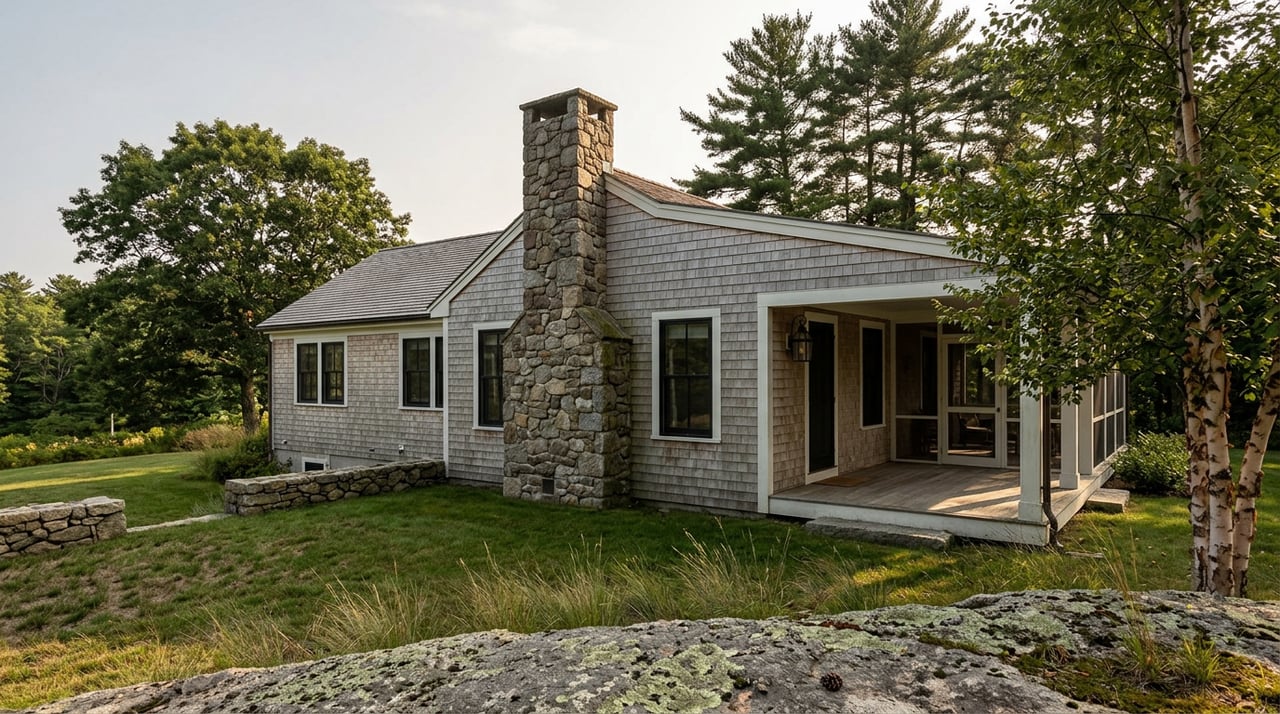
Tuftonboro Lakefront Setback Rules for Nonconforming Homes
September 24, 2026
September 24, 2026
A New Hampshire Municipal Association case update reports that in 1999, the owner of a house on Lake Winnipesaukee in Tuftonboro's Lakefront Residential District asked the town for a building permit. The plan was simple: add a second story over part of an existing house that already sat inside the shoreline setback. The town's building inspector signed off, noting the addition would cause no change in footprint. That single sentence would end up mattering for the next fifteen years.
More additions followed in 2008 and 2009, again reaching into the setback, this time with a variance from the town's Zoning Board of Adjustment. Then, in 2014, a new survey turned up a problem nobody had caught: the 2008 addition intruded on the setback by more than anyone had realized. The neighboring property owners asked a court to order the unlawful construction removed. What started as a permit approved on a Tuesday afternoon became a case that eventually reached the New Hampshire Supreme Court.
The property, owned by an entity called Sawyer Point Realty LLC, sits in a district where Tuftonboro's zoning ordinance requires a 50-foot setback from the lake for primary buildings. That number is not a suggestion. It is the line the town drew decades ago to keep new construction back from Winnipesaukee's shore, and it applies whether the lot has been in a family for three generations or was bought last spring.
When the neighbors, the Dietzes, took the setback violation to court, Sawyer Point didn't argue the addition was legal. Instead, the owners asked for something called an equitable waiver under RSA 674:33-a, a New Hampshire statute that lets a landowner keep an otherwise-illegal structure in place if tearing it down would cost far more than any public benefit gained from removing it. The Zoning Board of Adjustment granted the waiver. The Superior Court upheld it. The Dietzes appealed again, arguing the board never should have granted relief without direct evidence on the cost of correction. The New Hampshire Supreme Court disagreed, ruling that board members could rely on their own knowledge of construction costs and that a landowner does not have to be denied a variance before qualifying for a waiver.
The case took fifteen years to resolve, three rounds of construction, one survey that changed everything, and a trip to the state's highest court, all over roughly fifty square feet of house that sat too close to the water.
Here is the part that should matter to anyone shopping Tuftonboro's shorefront right now: this is not a rare situation. Tuftonboro's own master plan acknowledges that most existing properties in the Lakefront Residential district predate the current dimensional standards and, as a result, do not meet them. In plain terms, a large share of the camps, cottages, and older homes lining Lake Winnipesaukee and Mirror Lake in this district are what the town calls legal nonconforming structures. They were built before today's setback rules existed. But the moment an owner wants to expand living space, enclose a porch, or convert a deck, the rules governing exactly what is allowed become central to what an owner can do next.
New Hampshire's Department of Environmental Services, which administers a separate but overlapping state law, puts it this way in its own guidance on nonconforming structures: nonconforming structures may be repaired or expanded, with some restrictions. The restrictions are the whole story. The Sawyer Point case is simply what happens when a footprint measurement turns out to be off by a few feet nobody double-checked until years later.
Part of what makes this tricky is that a Tuftonboro lakefront property isn't governed by one rulebook. It's governed by two, and they don't always draw the line in the same place.
| Tuftonboro zoning (Lakefront Residential district) | New Hampshire Shoreland Water Quality Protection Act | |
|---|---|---|
| Protected zone from the water | Extends to the rear lot line or 600 feet, whichever is less, from full lake elevation | 250 feet from the reference line |
| No-build buffer for structures | 50-foot setback for primary buildings (does not apply to boathouses) | 50-foot no-build buffer for new construction |
| Minimum shorefront frontage | 150 feet along the reference line | Not separately set by the state act |
| Impervious surface | Addressed through site plan review, case by case | Capped as a percentage of the protected shoreland, often reached quickly on smaller lots |
Both layers apply at once. A project that clears the town's setback can still run into the state's impervious surface cap, and vice versa. The state act also makes clear that towns are free to set stricter rules than the state minimum, and Tuftonboro's own zoning does exactly that in a few places. A for-sale listing may not show every land-use restriction; a buyer considering a bedroom addition can ask about the property's existing footprint and permit history.
As of July 2026, the median home sale price across all of Tuftonboro sits at $799,000, while the average sale price is considerably higher, north of $1.25 million. That gap is worth sitting with. A median close to $800,000 and an average well above $1.2 million means a small number of high-end waterfront sales are pulling the average up while the bulk of transactions, many of them inland or off-water, cluster well below it. Houses in town have been taking around 86 days to sell on average this year.
That spread matters because Tuftonboro's overall housing stock is not one market. It's at least two: the inland homes on two-plus acre lots that make up most of the town's low-density residential zoning, and the narrower band of true Lakefront Residential parcels along Winnipesaukee and Mirror Lake, where the setback rules above actually apply. A buyer comparing "Tuftonboro's median price" to a specific shorefront listing is often comparing two different products. The lakefront parcel isn't just paying for water frontage and a view. It's paying for a specific, often already-maxed-out allotment of buildable footprint, and that allotment is worth more or less depending on how much of it has already been used by additions built decades ago under rules that no longer apply.
If a lakefront camp or home in Tuftonboro has you picturing what it could become, a few questions are worth asking before an offer goes in, not after:
None of these questions are meant to talk anyone out of buying on the water. Tuftonboro's shorefront, split among villages like Mirror Lake, Melvin Village, and Winter Harbor, remains one of the more understated stretches of Winnipesaukee frontage, helped along by a town tax rate that has stayed comparatively low, $6.40 per thousand of assessed value as of 2025. The questions are meant to make sure the price being paid actually reflects what the house is legally allowed to become, not just what it looks like from the dock on a July afternoon.
Does nonconforming status affect financing or insurance? It can. Lenders and insurers sometimes ask directly whether a structure is legal nonconforming, and a documented history of variances or waivers is usually easier to work with than an undocumented one discovered mid-transaction.
Can I find out about a property's permit history before making an offer? Permit history at the town office and through the state's shoreland permit tracking system is the kind of homework worth doing early rather than during a due diligence window.
Does any of this apply to homes that aren't directly on the water? The 50-foot setback and the state's protected shoreland only apply within the mapped zone around qualifying waterbodies.
Sorting out which rulebook applies to a specific parcel, and what's already been built into or against its limits, is exactly the kind of groundwork that turns a hopeful offer into a clean closing. If you're weighing a lakefront camp in Tuftonboro or anywhere else around Winnipesaukee, Martha Trepanier has spent years working through exactly this kind of local detail with buyers and sellers. Let's Connect.
This article is general information, not legal, tax or financial advice. Consult a qualified professional about your situation.
Stay up to date on the latest real estate trends.



Partner with a seasoned professional who knows every corner of the Lakes Region. From navigating the initial search to securing the keys, you will receive dedicated, one-on-one guidance tailored to your goals. Let’s make your transition to the Wolfeboro area seamless, stress-free, and successful.
ADDRESS
305 N Line Rd
Wolfeboro, NH 03894
OFFICE ADDRESS
15 Railroad Avenue
PO Box 738
Wolfeboro, NH 03894
Mon - Sat: 8AM - 10PM
Sun: 11AM - 4PM